Friends of
CRATER LAKE NATIONAL PARK
Volume 10 No. 1 * Spring 2005
Volume 10 No. 1 * Spring 2005
|
Friends of
CRATER LAKE NATIONAL PARK
Volume 10 No. 1 * Spring 2005 |
|
Construction this summer not
limited to the Rim Parking area Traveling from Medford? Watch Road Reconstruction on Highway 62 in the Park!
Planning began years ago for the reconstruction of West Highway 62 entrance road to the Park. Project data sheets show that this project was well underway in early 2000. As in any road reconstruction project, this project has as its primary goal, visitor and staff safety. Historically, there have been 28 accidents on this section of road in the years 1997 to 1999. If one were to walk from the West Park Boundary to the Annie Creek turn off, large cracks in the road and the sloughing off of pavement along the edge of the road would be easily evident. One can also easily imagine that a road built over twenty years ago was not designed for the enormous vehicles that regularly travel this critical section of roadway in summer and winter. History of trails and roads in the area There have actually been at least four trails, wagon roads, and auto roads in this area of the Park since the lake's pioneer discovery in 1853. If one wants to turn the clock back another thousand years, there were indeed foot trails in the area to the important huckleberry picking areas just west of the Park. Wagon roads were carved out of the forest by the first pioneers and followed the Rogue River from Jacksonville, up and over the Cascade Divide in the area of Castle Creek, and then down the eastern side of the Cascades along Annie Creek. If one wished to hike the seven ''wagon roads'' still evident in the Park today, the area around West 62 would be great place to discover several. One original wagon road to the rim was sculpted by J.M. Sutton in 1869. He cut small trees to clear the way for wagons which still serves as the Dutton Creek hiking trail. But major pioneer wagon roads from the east to the west were first built in 1863 by army troops and crossed the Cascades in Southern Oregon in the area of Mt. McLoughlin. This first road ran through Butte Falls and into the Rogue Valley. It was a very difficult route and was replaced by the Fort Klamath - City Jacksonville road, our "West Entrance" road also built by troops from Fort Klamath in 1865. The area did not change much until the area became a National Park. The first superintendent, Arant, relocated the West road and had several "corkscrews" in it as it was used from 1906 until 1915. These sections of roadway are still visible in the area of our "west corkscrew". One way to know that you are on an historic wagon road is to watch for blazes and carvings in the trees or arborglyphs. These markings signaled not only the roadway but also areas to camp with water. Several areas seem welcoming including Thousand Springs, Whitehorse Creek, Dutton Creek (Lower Campground), Pymal Camp, Oklahoma Camp, Annie Springs, and Victor Heights (at the rim). One would find more blazes in these areas. The road today was first constructed and located by the NPS and the Bureau of Public Roads in 1914-1915 and actually built by the Army Corps of Engineers. During the years 1925-1928 the NPS and the BPR rebuild the road for the first time. Again between 1972-1976 the NPS and the BPR widened the road and completed other reconstruction measures using private contractors. This is the road we use today. With the improvement of roads came a change in the way visitors both traveled to and recreated in the Park. The first wagon roads included several camps along the way for small groups of travelers. But in 1905 Arant also rerouted both the west switchbacks and the roadway to the rim from Dutton Creek to Munson Valley. This allowed the young Park Service to register more park visitors as they passed the headquarters area at Annie Springs. In 1907 a concessionaire established a tent camp next to the Annie Creek Headquarters and so began commercial visitor services in the park. So, the visitor experience in traveling to Crater Lake changed in very important ways with the development of automobile roads; faster roads meant shorter stays, larger camps ended dispersed camps along the way, and the personal connection to the forest was replaced by a group experience.
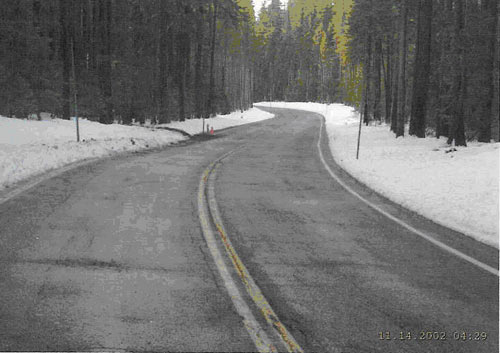
Project Plan The auto road today is hazardous for several reasons including a blind curve at Whitehorse Crossing, two switchback curves as the road ascends the Cascade Divide, and an unimproved parking area at the Pacific Trail crossing. It is also aged and in desperate need of rebuilding. The Park Service requested $4,344,000 in March of 2000 to rebuild and reconstruct 7.7 miles of road from the west park entrance to the Annie Creek junction and entrance station. Parts of the road from the ''Old West'' boundary to the current boundary have recently been! received from the Oregon State Highway Division and are not up to NPS standards. There are about 50,000 vehicles on this section of road every year. The West Highway 62 road is critical to movement into and out of the park and requires this rebuilding to assure it continued availability. Roads in our National Park Service areas are planned to "lie lightly on the land". The contrast in the NPS mission again it can be observed in its road building stratgy, to preserve and protect as well as open for the enjoyment of the visitor. Here the NPS hopes to provide a road that is not to be used for a road''s usually perceived use...speed and comfort. Park roads may be narrow, winding, and hilly, a very different use of a road, to enjoy the drive and the views . The limited view from Highway 62 in this photo is part of the reason for the reconstruction...there is no view from the road, or indeed! what is beyond the next corner. Impact to visitors The summer of 2005 may prove to be a very frustrating time to visit Crater Lake. Major construction projects are planned and beginning in the Rim Village area, the Mazama Village area, and the west entrance road (Highway 62). This summer it is recommended that visitors get current park conditions before traveling to the area. Visitor services will be very different when compared to summers past.! It would probably be wise to travel as our pioneer ancestors did, with all the equipment and supplies to camp and eat without the help of a concessionaire. It will truly be the summer for the robust visitor...but also the summer for frustrations in those that are not. |