|
Friends of Volume 4 No. 2 * Spring 1999 |
|
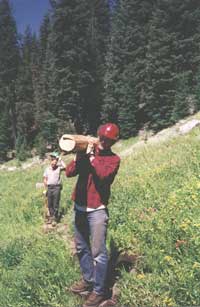
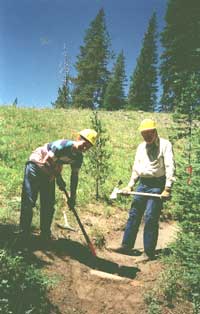
President's Report I am happy to have a friend volunteer to fill the vacant board position. Marvin May of Bend, OR is our new member of the board. The Friends Board met May 1, 1999 at historic Jacksonville, OR. It was decided to contact the Oregon Department of Transportation and Adopt one of the highways to Crater Lake. Greg Hartell contacted ODOT and the Friends will have 3.5 miles of the Highway 62 from the South entrance to the Interpretative Turnoff toward Fort Klamath. If other Friends in the other gateway communities are interested with the highways to the park contact the board member in your community. This will be an especially big challenge for board member Donald Rome. It would be nice to have the Friends adopt other entrances to Crater Lake. The Friends has gotten a few new members, please keep looking for more friends! We need more members for the projects. The Friends thanks Steve Mark for the series on the Park History in the newsletter. I am looking forward to this summer Friends projects. As Amy writes, Collomia Mazama planting will happen when the snow melts. Glen Kaye is actively working on 2002. Bev Hartell is working on T-shirts and stationary. The Crater Lake trail crew will be thinking of the volunteer weekend project in August.
|

|
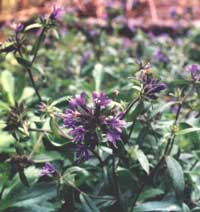
Collomia Mazama Planting By Amy Mark With 146 inches of snow still on the ground, it is difficult to start thinking about "Spring" projects at Crater Lake. Some of you have participated and others have read about Friends helping with the planting part of the Collomia Mazama Conservation Strategy. This is a rare plant found in Crater Lake National Park. There is one last opportunity to participate in this planting project. It is scheduled for the first or second Saturday in July. Due to the big snow year, we'll be unable to predict the exact date until two or three weeks in advance. The planting project involves carrying plant plugs from the Crater Creek Trail head (Rogue River National Forest) to the planting site near Sphagnum Bog, a 4.5 mile round trip hike. As many as 400 plants need to be transported and planted. Friends have helped with this planting during spring and the fall of 1998. Some members meet at Hamaker Campground Friday evening for a dinner and camp out (this makes it convenient to car pool to the trail head in the morning). Others meet at Crater Creek Trail head at 9a.m. Often the project is completed by 2 to 4:30 p.m. depending upon the number of plants. Many of you may want to learn more about Mount Mazama Collomia and its conservation strategy. There are a couple of opportunities available coming soon. Casey Baldwin, the primary researcher from the University of Idaho has prepared some information and photos for the park's website. Casey has also prepared an article to appear in the 1999 edition of Crater Lake Nature Notes, available in July. If you would like to be included in a mailing with the specifics of the planting and camp out please call me (541) 381-2286. |
|
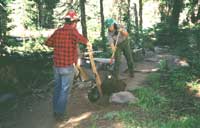
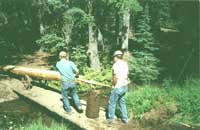
1998 Trail Project Weekend: | ||
|
|
|
|
Crater Lake National Park's Centennial (second in a series) With efforts to establish a national park around Crater Lake effectively stymied by 1889, Will Steel began looking for other ways to gain the protection be sought for this area. An acquaintance of his, John B. Waldo, advised Steel as early as 1885 that he ought to petition for reservation of the entire Cascade Range in Oregon. Although Steel opted for only ten townships around Crater Lake at first, he remained open to a more ambitious reservation once a national movement to retain federal ownership of forest lands gained momentum in the late 1880s. Part of an Oregon pioneer family that settled east of Salem in 1843, Waldo served as chief justice of the state supreme court from 1884 to 1886, and won one term as state representative in 1888. He loved mountains, avidly read Thoreau, and spent much of each summer in the wildest and most remote parts of the Cascades. During the summer of 1888, for example, Waldo and his companions made the first recorded journey along the crest between Mount Jefferson and Mount Shasta. They made the trip because Waldo intended to have the legislature ask Congress for a huge "public reserve or park." It was to encompass 12 miles each side of the Cascade Divide and run along the entire length of the range in Oregon. Settlement and logging would be prohibited and other uses regulated so that water supply, game, and recreation could be perpetuated for all time. This memorial of 1889 met defeat in the state senate, so it never left Salem. Congress did, however, pass legislation in 1891 allowing the President to proclaim "forest reserves" from any land still in the public domain that had trees or was covered with undergrowth. The Oregon Alpine Club, headed by Steel, now became the leading proponent of establishing forest reserves in Oregon. Their first success came in 1892, when the Bull Run Forest Reserve was created to protect Portland's water supply. It took another year before President Grover Cleveland acted to establish the nation's largest reserve. The Cascade Range Forest Reserve came into being (along with a much smaller reserve near Ashland) on September 28, 1893 and encompassed 4.5 million acres that later formed the basis for several national forests. Within its boundaries was the earlier Crater Lake reservation made during Cleveland's first term in office. Steel saw the new reserve as a way to buy time for his national park proposal, in that the proclamation was more permanent than the 1886 withdrawal of ten townships. Congress, however, still had not appropriated any funds nor provided direction in the management of forest reserves. Unregulated sheep grazing on the reserves represented an immediate threat in the eyes of many forestry advocates. They saw the animals as responsible for denuding forest cover and thereby degrading how the reserves held water for agriculture and municipal use. Many herders burned large areas to improve forage, impairing visibility for months at a time and contributing to the loss of prime timber. When the Secretary of the Interior issued an order prohibiting grazing on the reserve in 1894, the sheep owners attempted to fight back through the Oregon delegation in Congress. The delegation led an effort to severely reduce the Cascade Range reserve while some sheepmen openly defied the Secretary's order. Things came to a head in 1896, when Steel spent most of six months in Washington, D.C. orchestrating a lobbying campaign in defense of the reserve. After some close calls it emerged intact, so Steel came back to Oregon in June with the intention of leading a trip to promote interest in Crater Lake. He wanted to bring the Mazamas, a mountain climbing group Steel started in 1894, to southern Oregon for an ascent of Mount McLoughlin and some extended camping at what later became known as Rim Village. In early August a deputy U.S. marshal was sent to Crater Lake to arrest sheepherders who had brought some 2,000 sheep into the area. This resulted in four sheep owners having to appear in federal court, where charges were dropped in view of the judge's warning to keep sheep away from Crater Lake thereafter. The Mazamas gathering that August was important in several ways. Fay Fuller, as one of the Mazamas, had the honor of christening the mountain holding Crater Lake and naming it after the organization. Secondly, Steel prevailed upon several government scientists to conduct various studies of the proposed park area. The investigators presented their findings to the campers throughout the week (the first formal interpretation at Crater Lake) and subsequently published research papers in the annual journal of the Mazamas, This volume served not only as a record of the trip but was also intended as the first guidebook for visitors to Crater Lake. Steel had to cut his time with the party of Mazamas short because he had to meet a special forest commission in Medford and bring them to Crater Lake. The controversy over federal forests had by now prompted Cleveland to appoint a body to make recommendations about the number of reserves and their future management. Steel naturally thought it critical to discuss the fate of both the Cascade Range reserve and Crater Lake with the commission. He walked from Rim Village to the train depot in less than three days and arranged for wagons to transport the commissioners back to Rim Village. The weather had turned wet and misty by the time they arrived at the rim, but Steel convinced both John Muir and a young forester named Gifford Pinchot to join him in camping at the lakeshore for one night in hopes of reaching Wizard Island the next day. Rain and rough water canceled the boat trip, though Steel appeared to have succeeded in obtaining the commission's support for retaining the forest reserve and establishing a national park at Crater Lake. The commission's final report recommended retaining existing forest reserves and adding some new ones, but remained silent on a national park at Crater Lake. In June of 1897, Congress passed legislation giving a degree of permanence to the reserves and provided funds for their management. They provided a somewhat utilitarian direction, allowing the location of mineral claims as well as authorizing uses like logging and grazing at the Secretary of Interior's discretion. The Secretary drew up regulations to implement the legislation and included a provision banning sheep from the area near Crater Lake. This conveyed some of the protection Steel desired but he worried about a clause in the new law allowing the President to reduce, modify, or eliminate forest reserves at any time. (to be continued)
| ||
|
Crater Lake Fee Demonstration Program By George Buckingham Chief Park Ranger, Crater Lake National Park As most of you know, the National Park Service has been authorized by Congress to embark on a Fee Demonstration Program. One of the key components of this program is that most of the fees collected remain at the park where they are collected. At Crater Lake, this means that 80% of fees collected remain in the park. This is a demonstration program authorized until 2002. Congress and the administration are watching the NPS very, very closely. While we pride ourselves in spending money wisely, this program definitely has our full attention. Not only do we know we are being watched, we also realize this is a tremendous opportunity to accomplish goals which we have languished for years with no real hope of being accomplished. This is too valuable a program to lose. So, just what are we doing with this money? First we pay to collect the money. This cannot exceed 15% of what we collect. We have completed the chip sealing of one mile of Hiway 62 at the West entrance. I'm sure you know that road needs help! Nearly completed is a high profile project, the replacement of the boat fueling system at Cleetwood Cove. This should result is a significant reduction of the threat of gasoline spillage, much improved safety and elimination of a visual blight. We have replaced two entrance signs, duplicating signs used in the 1930s. A sign for the North Entrance has been built and will be installed this summer. So far, we have received only very positive comments on these new "old" signs. Several other historic park signs have been replaced. The next really large project is restoration of the Watchman Fire Lookout. It is sorely in need of physical restoration. We also plan to utilize the structure as a visitor interpretive opportunity concentrating on the role of fire in the park ecosystem. This project will take at least two years to complete, but when done will be a real showplace. Most of the park trails are actually old fire roads which have simply been redesignated as trails. Hiking them is less a wilderness experience than it could be. We are embarking on a program to convert these to single lane trails. We also plan to replace all the back country trail signs. Revegetation of back country trails and campsites will also be accomplished, as well as of picnic areas, trailheads and overlooks. Several interpretive improvements are also in the works. A Lake Ecology video, an improved Traveler's Information System Network and improved exhibits. We have many more projects planned. Implementation is somewhat complicated by an extensive approval process by the Washington Office and the obvious requirement of collecting the funds before they are spent. Seeing so many projects being accomplished makes this an exciting time to be working in the park. |
|
Serendipity by Greg Hartell Over the past several years, I have had the good fortune to work on a number of construction projects at Crater lake. I live in the Klamath Falls area south of Crater Lake and have often had people comment, "That must be quite a drive?" in reference to the 50 mile distance. Late winter and early spring storms, along with the early morning darkness, sometimes makes the traffic content to follow ODOT's slow moving sanding trucks along Klamath Lake and up icy Hwy.97 to the Hwy.62 Junction. Hwy.62 is usually unplowed in the early morning but vehicles from the Fort Klamath area have broken the track. If you are early enough and lucky enough you can be the first track on an unplowed highway from Ft. Klamath to the South Entrance of Crater Lake. There, the NPS crews nearly always have the road in ship shape condition. Each day one can find a sign of the advancing seasons. As the days lengthen a sunrise will appear m your rearview mirror, the ice breaks up on Klamath Lake and above Fort Klamath the top two wires are now visible on the ranch fences; so it goes day by day. The willows are the first to know that spring is coming and as the roadside snow recedes, they put on a show of color with golden yellows and ambers followed closely by the wild rose with its red briers. Now that Klamath Lake has opened up, the birds are returning, ducks, pelicans, arctic terns, cormorants, and my favorite, the Grebes. Up through the Wood River Valley Mallards and Cinnamon Teal work the ditches, Redwing Blackbirds and Meadow Larks sing from the fences, Kildeer race along the gravelly road shoulders, and a Bald Eagle is perching on an aspen tree limb at the old Briscoe place. Up in the park, the snow pack has melted back from the road shoulders (even though it is still 12' deep) leaving the snow less exposed. Also visible in snow pack is the natural graphic record of each snow fall in the form of horizontal lines caused by the varying granular structure of the snow at each snowfall. In this manner, spring marches up the mountain and yes, I must agree it is quite a drive.
Lava Beds National Monument, 50 miles south of Klamath Falls is celebrating its 75th year as a National Monument. Friends should be interested in and watch for upcoming workshops and events. I attended the Living History Weekend May 8. The Lava Beds has a very sad but wonderful history that the historic re-enactors helped to tell. I will be real interested in attending other events. The actual anniversary will be celebrated November 18-26 with a ceremony on November 21, the actual 75th anniversary. |
|
U.S. Department of the Interior Celebrates 150 Years While the Friends anticipate 2002, 1999 is the anniversary of the federal agency the National Park Service and Crater Lake National Park are part of. For Friends who are history fans, 1999 is the 150th birthday of the creation of the Department of the Interior. The constitution had not planned the executive branch in any detail. Executive power was vested to the president but the constitution only assumed the existence of "executive departments". Congress defined the executive departments in 1789 when it created the Department of State, Treasury, and War. For 60 years the government functioned with 5 executive departments, the Post office was added late in 1789 and Department of Navy had been added in 1798. The Constitutional convention in 1787 had proposed a 'home department' headed by a secretary of domestic affairs. Congress reasoned the benefits of another executive department was not worth the additional bureaucracy. Expansion of the bureaucracy was intertwined with the organization of new territories and the extension of slavery. So the internal affairs were divided among the existing departments. The Patent Office was administered by the Department of State, Indian Affairs were managed by the Sec. Of War, and General Land office by the Secretary of Treasury. The 1840's expanded the continental United States to nearly its present size. The annexation of Texas in 1845, the Oregon boundary dispute in 1846, and the conclusion of the Mexican War in 1848 enlarged the US by one million square miles. President Polk's Secretary of Treasury, Robert J. Walker, for saw hordes of lobbyists and speculators, drawn by the prospect of large profit in the new territories, swarming and corruption the Treasury Department. The General Land Office, which oversaw the disposal of public domain, was in the Department of Treasury because of revenues generated from land sales. Secretary Walker also reported the Patent Office in the State Department, the Indian Affairs Office in the War Department, and the Pension offices in the War and Navy Departments should be brought together in a new 'Department of the Interior'. Senator Jefferson Davis of Mississippi and Senator Daniel Webster of Massachusetts favored the establishment of the new department. Debate centered around fears of expanding the central government and sectional issues but the vote divided on party lines with Democrats reluctant to create a new department for the Whig party which was entering office. The DOI was at first government offices that handled matters such as patents, pensions, Indian affairs, and others that fit nowhere else. As the US expanded, DOI supported settlers and government making national growth a high priority. An appropriate name might have been 'The Department of Western Development'. The Department has changed to a conservation organization when it was realized the public domain would not last forever and now it is environmental protection because of pollutants. Friends who wish to learn more about the Department of the Interior I recommend "The Department of Everything Else" by Robert M. Utley and Barry Mackintosh.
| ||