|
SINNOTT MEMORIAL OBSERVATION STATION AND MUSEUM
by Greg Reddell
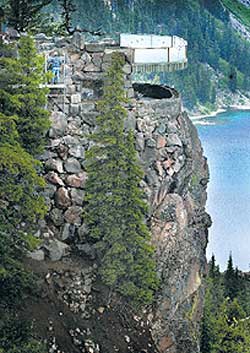
Crater Lake National Park will be reopening the historic Community
House (1924), the unique Sinnott Memorial Overlook (1931), and the Kiser
Studio (1921) during the centennial summer. Friends remember visiting
these buildings on the Rim Village at the morning seminars during the
annual meetings. Other structures at the Rim Village, including the
stone walls and observation bays of rustic design have also been
restored.
The Sinnott Memorial was built over Victor Rock, a popular lake
viewing site. It was constructed of large rocks that united with the
caldera wall and was a prototype of rustic architecture in the national
park system. It has been used as a museum, a contact station, and a
viewing point.
The Nicholas J. Sinnott Memorial Observation Station and Museum was
built with a $10,000 appropriation made by Congress on July 1, 1930.
Sinnott had been a member of the House of Representatives from Oregon
during 1913-28 and as chairman of the Committee on Public Lands from
1919-29 had been a strong supporter of Crater Lake National Park. He
died in 1929. The Sinnott Memorial is significant since it was the
first museum building to be constructed in a national park with funds
provided by a specific congressional appropriation.
Construction of the Sinnott Memorial, located on Victor Rock, was
started during the fall of 1930. Through the cooperation of the Carnegie
Institution, the sum of $5,000 was made available for placement of
exhibits and telescopes in the memorial.
The Sinnott Memorial was dedicated on July 16, 1931. Among those
that attended the ceremonies were NPS Director Horace M. Albright and
William G. Steel. During the summer of 1931 exhibits which included a
relief model of Crater Lake and vicinity presented to the park by the
Crater Lake Company, exhibits related to the color of the lake's water
and the color of light transmitted through the water, and a charred
cross-section of a log of ponderosa pine which had been found buried
beneath 60 feet of ash at a road excavation were placed in the Sinnott
Memorial. Now that the Sinnott Memorial has been rehabilitated, some
more exhibits are planned for the museum.
|
|
CRATER LAKE'S SUPERINTENDENT NO. # 1
by Greg Reddell
The General Land Office was administrating the lands of Crater Lake
as part of the Cascade Range Forest Reserve from 1893 to 1902. The few
forest reserve rangers hired to patrol the Reserve were busy controlling
grazing, preventing wildfires, and were busy establishing the forest
reserve boundaries. On May 22, 1902 President Theodore Roosevelt signed
the bill giving Crater Lake national park status. Not much later, on
June 7, 1902, William Arant was named superintendent of Crater Lake
National Park. Superintendent Arant assumed his full-time duties in
October and served as superintendent until July 1, 1913.
The early
National Parks, which Crater Lake is an early park, were established
before the creation of the National Park Service. Before the
establishment of the National Park Service by an act of August 25, 1916,
administration of national parks was under the direct supervision of
the Secretary of the Interior. Most of the work was performed by the
Patents and Miscellaneous Division until 1907 and thereafter by the
Miscellaneous Section of the Office of the Chief Clerk.
Appropriations
for Crater Lake National Park remained small and barely adequate to
maintain park operations during the 1902-16 period. Superintendent
Arant had a salary of $900 and a horse expense account of $100.
Congress allocated annual sums of only $2,000 for fiscal years 1902,
1903, and 1904 and Arant operated Crater Lake at a bare minimum
subsistence level without many funds for improvements or protection
services. Appropriations for the park increased slightly to $3,000 per
year during 1905-07. There are practically no roads inside the Park,
except for the old Fort Klamath -- Medford Road, constructed by the
soldiers of the fort. Travel to the Lake is entirely by trail. Between
1903 in 1912, a narrow road is constructed to the Rim.
William F. Arant
was 52 years old when he became Superintendent. William F. Arant was
born on September 29, 1850, in Central Illinois near Peoria, the son of
Jesse T. and Mary Jane (Emmett) Arant. The family of twelve children
resided in Illinois until March 12, 1852, when they left for Oregon,
crossing the plains in ox-pulled wagons. Jesse Arant's family
arrived in Oregon in September and located in the southern Willamette
Valley in Linn County. After a year they moved to Douglas County, where
Arant's father secured a "donation claim" of 320 acres some seven miles
northwest of Roseburg in September 1853. Arant's father farmed and
raised livestock.
William Arant acquired a common school education and
worked on the home farm. On October 29, 1871, he married Emma L. Dunham,
who had come to Oregon with her family in 1864 from her birthplace in
Missouri. In the fall of 1872 William Arant moved his family to Klamath
County, where he engaged in farming and stock raising for some thirty
years. His ranch was east of Klamath Falls on the road to Lakeview (Hwy
140) about a mile. He became active in Republican Party political
circles in southern Oregon. He serving in the state militia for five
years--one year as private, one year as company bugler, two years as
first sergeant, and one year as guidon sergeant. During the Modoc Indian
War in 1872-73, he served as a teamster in the employ of the U.S.
Government and engaged in furnishing supplies to the troops. In 1892 he
won the championship medal as the finest shot of Troop B, one of the two
cavalry troops in the state.
During those eleven years he was Superintendent, Arant wintered at
his home in Klamath Falls, devoting attention to his private farming and
stock raising interests. He lived the first summer as Superintendent in
Crater Lake National Park in a tent near Annie Springs. Summer
visitation was very few at first. We do not know what visitation was in
1902, but 1904 was estimated to be 1,500. There was no need for very
much presence at Crater Lake during those early winters. In 1905
construction began for a park office and superintendent dwelling at Anna
Springs. Early building attempts were foiled by winter snow smashing
the building. Superintendent Arant lived in a tent for three summers,
camping at Cold Spring until the snow melted at Anne Springs.
|