|
Friends of Volume 4 No. 4 * Fall 1999 |
|
MEMBERSHIPS We'd like to remind everyone to keep their membership current. Just look on your address label and you can tell when your membership is up for renewal. We'd also like to encourage you to keep us in mind when trying to think of a gift for someone this holiday season. That person just might enjoy being a member of Friends of Crater Lake and receiving our newsletters a few times a year. This is another way you can support our organization and get the word out about what we are doing to help the Park. In the coming year we are hoping to get a Park Pal program going--perhaps a day next summer for kids to gather in the Park and hear a talk about trees or birds or animals, go for a walk, roast some hot dogs, and do some kind of craft activity. If you know of a child who might enjoy this kind of activity, why not give them a Park Pal membership. If you are a teacher, perhaps your class would like to do this kind of activity during the Spread the word. If we generate enough interest, we will even send out a newsletter designed specifically for kids. If you need brochures detailing membership information, give Judy a call or write and she will be happy to forward the number of brochures you need. |

|
CENTENNIAL PLANNING AND THOUGHTS Many businesses and foundations have been invited to participate in the park centennial, but it's important to point out that the most successful fund-raising campaigns are those that have many modest donors. Rarely do campaigns succeed when they hope to find a single large contributor. Indeed, most donors expect to see matching contributions, and a high percentage of contributions from the organization involved. With that in mind, do look over the following important projects that have been targeted for the 2002 centennial. These are on the list because they can have significant impact in cultivating public understanding about Crater Lake and its resources. If one of these is especially appealing to you, do consider a special contribution to help make it happen. If you have a working relationship with someone associated with a business or foundation that might be interested in providing support, please contact Glen Kaye by phone at 503-587-8917 or E-mail at GFHLKaye@aol.com.
Glen Kaye is the most recent addition to the Friends of Crater Lake Board. Glen retired after a career as a park naturalist (interpreter) with the National Park Service, and before his retirement served as the Regional Chief of Interpretation in Santa Fe, New Mexico. He and his wife and now live in Salem, Oregon. Glen has worked in a number of parks with volcanic resources, including Lassen Volcanic National Park, Hawaii Volcanoes National Park, and Rocky Mountain National Park. He began his career at Crater Lake National Park in the early 1960s. He is the author of numerous publications on the natural history of parks. |
MT. MAZAMA COLLOMIA PLANTING The last planting of Mt. Mazama Collomia was successfully conducted on Saturday, July 31st. Four hundred seedlings were packed into the Sphagnum Bog restoration site and planted. To date, the Friends of Crater Lake have planted approximately 1000 individuals with over a 90% survival rate. Most of the observed mortality is due to grazing by deer. The efforts of the Friends of Crater Lake have made a significant contribution in the restoration of this beautiful plant to the park. The Bakers, veteran planters from the Spring 1998 planting, were both surprised and gratified with the survival and robustness of the individuals they helped to plant. Mt. Mazama Collomia is a rare member of the phlox family endemic to Crater Lake National Park and adjacent lands on the Rogue River and Winema National Forests. 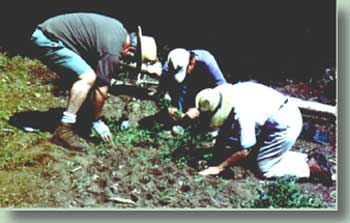
This delightful plant was discovered in 1896 by F.V. Coville while on an excursion with the Mazama's to garner support for creation of the park. Today, populations can be found along the pacific Crest Trail and in the vicinity of Sphagnum Bog. Approximately 25% of all known populations are protected within the park boundaries and they contain a significant portion of the genetic diversity found within the species. Prior to restoration efforts, the population near Sphagnum Bog suffered sever reduction in population size due to construction of the old fire road and subsequent use of the area by horse packers. The current restoration project is aimed at helping to maintain diversity within the park by increasing both the number of individuals and the genetic diversity at the site. Currently, seedlings and plant material grown from shoots are being evaluated to determine if there is a difference in survival, plant height, flower number or seed production. This information will then be used to help park managers in the event thatched need to replant other locations. 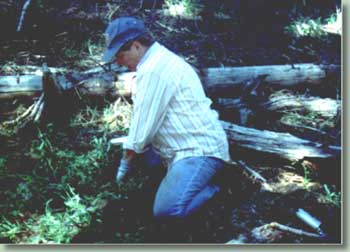
Through efforts like those from the Friends of Crater Lake, and with continued management efforts by the National Park service, it appears very likely the Mt. Mazama Collomia will be around for the Bicentennial of Crater Lake National Park. A more comprehensive discussion of current research on Mt. Mazama Collomia will appear in the 1999 issue of Crater Lake Nature Notes. |
NATIONAL PARK SERVICE HAS WORST RECORD IN DEPARTMENT OF THE INTERIOR No, that is not a misprint. The National Park Service does indeed have the worst safety record in the Department of the Interior and perhaps in the entire federal government. For most of us, this is an appalling revelation. We like to think of ourselves as a caring organization, a "family." How can an outfit that prides itself on the care it gives its employees and the zeal we bring to our mission put 10% of its people into a doctor's office every year? For decades the NPS has had a safety program. Primary program responsibility was placed in the hands of a park safety officer. I was one of those for 15 years. It sort of worked like this. Take the dumbest and least experienced employee (me); tell them s/he is going to save the world by making his park and its employees "safe." We bravely marched forth. We made speeches, we performed inspections, and we told everyone they weren't safe. We quickly became the most despised people in the park, a real nuisance. So we tried harder and became even more unpopular. And our safety record got worse. The next step was to form an employee-based safety committee and make them responsible for safety. They did much the same as the safety officers had done. They had lots of responsibility and enthusiasm, but few resources and little authority, a bad management practice. Result? We had even more unpopular people irritating an already overworked staff who felt they didn't need even more work to do (i.e. "safety"). The safety record just got even worse. Bob Stanton, Director of the National Park Service doesn't like this distinction. Neither does the Pacific West Regional Director John Reynolds, nor does Crater Lake National Park Superintendent Chuck Lundy. For that matter, nobody likes it; least of all those of us who have been injured (some of us for life). The Director has made improving our safety record one of his five major initiatives. John Reynolds forced all his superintendents to attend a special safety training session. (It was held in Hawaii, a punishment claims Chuck Lundy.) Chuck Lundy was so impressed that he organized another session held in Ashland this fall, required for all division chiefs and superintendents. Five parks in northern California and southern Oregon joined forces. (While Ashland is certainly a nice place and we were very well taken care of, more than one disrespectful wag made observations regarding who was sent to Hawaii and who was sent to Ashland!) So, what did we learn? We tried explaining away our miserable safety record with platitudes about how dangerous our work is and how hard we work and how much we care, that the numbers aren't significant. This just doesn't fly. DuPont, you know the guys who make gun powder and all kinds of other horrible chemicals, has a safety record that is something like 390 times better than ours! No I didn't make that up. I used the calculator built into this computer. So, we decided to adopt the same safety program that DuPont uses and hired their guy. That is who presented this training. The basic premise of this program is that safety is a line management responsibility. Line managers set the tone; they have the responsibility and the resources to make things happen. This can't be delegated. It starts with the Director and goes on down the line. At the park level, Chuck Lundy is responsible. He doesn't delegate that responsibility to the Division Chiefs. He holds us responsible and accountable. We in turn will hold the first line supervisors responsible and accountable. Eventually we hope that all employees will hold themselves responsible and accountable. We would like to see a work environment where every employee is empowered (a politically correct new buzzword, that we actually like) to work safely and to insist their co-workers do likewise. New features of this program include a new Safety Committee made up of the Superintendent and the Division Chiefs, which meets monthly for several hours. We will soon see these people spending even more time on the ground performing safety work. Another group of people is being recruited to form a safety-working group. This group will assist the division chiefs in performing specific safety related tasks, do research, provide feedback, etc. Most of these folks have been serving on the old safety committee. We hope to capitalize on their enthusiasm and care for fellow employees. We want every employee to know that a job isn't done right unless it is done safely. This will become an indicator of our competence just as protecting the resource and caring for park visitors is a hallmark of our competency. Rationalizing that we don't' have time to do "it" safely, that we can't afford safety, isn't going to cut it any longer. The truth is we can't afford (monetarily or any other way) to continue doing business as usual. Most of the Friends know that I am particularly fond of our structural fire truck, that I regard it as an extension of myself and am plotting to take it with me into retirement. Recently, to my great dismay, this vehicle was involved in a motor vehicle accident. Fortunately, no one was hurt, at least physically. The operator, an excellent employee and a fine person, feels terrible. In implementing some of the "new safety program", I decided not to concentrate on 'finding something stupid that someone did.' Just as our instructor told us, that is readily apparent and a waste of energy. Instead, we (my first line supervisors and I) examined our management systems, looking for weaknesses that allowed someone to do something stupid. It wasn't very difficult. We came up with a long list. Now the challenge is to correct those deficiencies. As you visit the park and volunteer your time and talents, we want you to participate in this new program. Let us know of anything and everything that is being done safely or not so safely. Do your thing safely or don't do it at all. |