|
Friends of Volume 4 No. 4 * Fall 1999 |
|
Crater Lake National Park's Centennial: (third in a series) 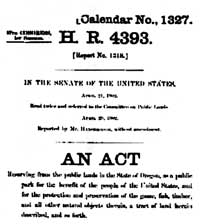
Once Congress began appropriating money for managing the forest reserves in 1898, staff hired by the General Land Office (the Bureau of Land Management's forerunner) could patrol them. Trespass grazing consequently ceased in the area around Crater Lake, but the few forest reserve rangers hired for that summer had several competing demands on their time. Their priorities also included preventing wildfires (a stand replacement fire that started north of Fort Klamath grew to 18,000 acres in September 1898 and gave Grayback Ridge its name) and establishing where the reserve's boundaries were located on the ground. Mapping efforts near Crater Lake ran ahead of other areas in the forest reserve, mainly due to the U.S. Geological Survey having begun work during the Cleetwood Expedition of 1886. Geologist Joseph Diller can be credited with taking the Crater Lake topographic sheet to publication in 1896, because it helped to illustrate his study of how volcanic forces shaped the area around Mount Mazama. Among the things Diller discovered in compiling the map was that the ten townships reserved in 1886 did not extend far enough east to encompass all of Crater Lake. He and others agreed that boundaries needed reworking, so subsequent bills aimed at establishing a national park were redrafted to reflect the dimensions of the USGS Crater Lake map. On it were features Diller thought directly related to Mount Mazama's climactic eruption and the geological story of Crater Lake. He deleted Diamond Lake and Mount Thielson in favor of including all of Mount Scott, then went far enough south to encompass such features as Union Peak, the Pinnacles, and most of Annie Creek Canyon. Thomas Tongue, a congressman from Astoria, introduced a new bill containing the reworked boundaries in January 1898. Supporters took heart when the House Committee on Public Lands issued a favorable report on the proposed legislation. The report, titled "National Park in the State of Oregon," consisted of testimonials by former Oregon congressman Binger Hermann (at that time commissioner, or chief, of the General Land Office) as well as Diller and the other scientists who had assembled at Crater Lake in 1896. The bill went no further, however, because of opposition from some key congressmen who saw national parks in places like Crater Lake as a continual drain on the Treasury with little hope for any real return on the government's investment. Enactment of legislation establishing Mount Rainier National Park on March 2, 1899, did not presage action on the Crater Lake measure. Tongue introduced another bill in the House, identical to the previous one, in December 1899. It, like another bill introduced in the Senate by the Oregon delegation three months later, went nowhere. Only when Theodore Roosevelt came to the White House in 1901 did the stars start to align. Tongue introduced HR 4393, worded identically to the bill he brought to the House almost four years earlier, in December. The same report from Interior accompanied it as in the three previous tries, but this time Steel acted on Tongue's advice to work up a petition and secure additional testimonials on Crater Lake. Steel collected 4,000 signatures on the petition by March and solicited endorsements from prominent figures both in and out of government. As might be expected, the replies he received from John Muir and Gifford Pinchot differed, since their views about the use of the forest reserves had openly diverged over sheep grazing in 1897. Oddly enough, Muir was noncommittal about Crater Lake's suitability as a national park. Pinchot, by contrast, expressed great enthusiasm to Steel. He also became a critical ally for the bill in his role as the new President's leading advisor on conservation and public lands. Pinchot went to Roosevelt about the Crater Lake bill, and the President had a word with the House speaker who objected to a floor vote on the legislation in mid March of 1902. This allowed the bill to be debated, but Tongue still had to negotiate with congressmen who could block any further progress. The House passed it on April 19, but with an amendment that allowed the location and working of mining claims. Three of the bill's six sections were deleted, though none of these (appointment of deputy marshals, payment of court costs, and authorization to deploy troops) constituted crucial sticking points. The most important provisions (park establishment, the boundaries described by Diller, along with authorization for the Secretary of the Interior to promulgate rules and regulations) remained. Action in the Senate took place swiftly. The House version was referred to committee on April 21, and its members reported favorably on it later that month. Passage of HR 4393 by the Senate came May 9 without debate or amendments. It became law on May 22, 1902, when Roosevelt signed the bill at his office in Washington, D.C. Steel wrote to the President the day after passage in the Senate to request the pen Roosevelt was to use in signing the bill. Pinchot, Diller, and Tongue also received letters that expressed Steel's gratitude for their part in the long campaign to establish Crater Lake as a national park. Almost a century later it stands alone in Oregon, even though national park proposals involving at least ten other areas within the state have been made at one time or another. Those efforts have so far failed for a variety of reasons, with perhaps the most important one being timing -- though the story of how Crater Lake National Park came to be also includes no small amount of perseverance and good fortune. (to be continued) |